
Pressure-test the decision
before it tests you
You run the company and make 100 decisions a day without breaking stride. This is not one of them.
70–75%
of acquisitions fail to meet expectations, even with full diligence and advisors
Gu & Lev, 40,000 deals (2024)
95%
of enterprise generative AI pilots show no measurable profit impact, for lack of readiness, not the technology
MIT (2025)
~25%
of the value in business transformations is lost at the target-setting stage, before implementation begins
McKinsey Global Survey (2021)
None of these is a failure of effort or intelligence.
Each traces back to the quality of the decision made first, while it could still be changed.
Not all decisions are the same. Some you cannot take back.
Ammentic is the independent pressure-test for the decisions you cannot take back, led by Ammara Abedi with people who have carried the same decisions. It works in addition to your deal and advisory teams, not instead of them.
It is built for the leaders who make the final call: the CEO or owner, and the operating partner or board behind them.
The answers to business decisions are everywhere now, and a machine will hand you fifty before lunch. What is scarce is judgment from people who have already made the decision you face. Ammentic pairs that judgment with the consulting rigor to turn it into a decision you can act on.
Which decision is in front of you?
If one of these is the call in front of you, Ammentic was built for you. Four questions. 90 seconds. At the end, what you may not be seeing.
Acquisition
We are about to acquire, and the model works. What are we not seeing?
Behind plan
We’re behind plan, and the explanations don’t add up. Is it the plan, the team, or the thesis?
Leadership
Is this the leadership team for the next stage, or the one that got us here?
The next dollar
Where does the next dollar really create value, and what are we funding out of habit?
AI
Everyone says move on AI. Where do we actually commit, and where do we hold back?
Succession
The founder is stepping back. Is the company ready, and is the successor real?
Exit
An exit is on the horizon. Are we ready, or are there gaps that will cost us at the table?
How we work, in brief
One engagement, three phases. It begins in confidence and ends with a verdict in writing.

1. The Read
Every engagement begins here. Ammara works in confidence with the people closest to the decision and surfaces the assumptions and unexamined risks beneath it.
2. The Pressure Test
The room gets both: three to five operators who have made this exact call and carried what followed, and Ammara pressing the decision with a consulting lens built across more than 100 executive engagements. The client is never named.
3. The Action Brief
A clear verdict in writing, with the reasoning behind it. Commit, commit with conditions, change it, wait, or do not commit.

Who leads it?
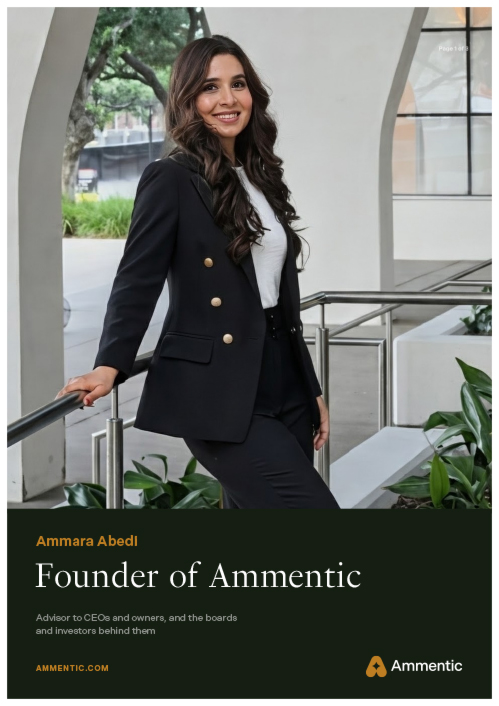
Ammara Abedi works with leaders at the moment a decision stops being reversible.
An organizational psychologist by training, she has spent 12+ years with leadership teams in oil & gas, healthcare, manufacturing, technology, and professional services, across more than 100 executive strategy engagements and over 70 one-to-one advisory relationships at the C-suite and senior level.
The Collective brings the experience. Ammara brings the structure that makes it count.
“Ammara does not let executive teams hide in comfortable, performative conversation. She pushes leaders, with respect, to confront the blind spots that are holding an organization back.”
CEO, community health organization
Client examples are anonymized; identities and affiliations are never disclosed.
Read the Ammentic introduction
How the pressure-test works and the decisions it is built for, with the executive bio of our founder, Ammara Abedi.

The decisions that set your direction deserve a real test before you commit.
It starts with one confidential conversation: ammara@ammentic.com